Click the Picture to go to the Video.
Lisa Hannigan - Safe Travels, Don't Die

 Our keynote speaker, Charles S. Prebish of Utah State University, gave examples of many of the different websites and their functions. I found the amount of different reasons and/or needs represented in these websites very surprising. They ranged from being purely informational to providing an online world, complete with temples and avatars, and everything in between. One of the bigger issues that he brought up was the commodification of Buddhism and if it's affect on the religion and the community was a good or bad thing. There are many sites that promote themselves as companies who will sell anything from books to crafts dedicated to Buddhism. Prebish even brought up a site that was dedicated to helping Buddhists find a relationship, much like match.com or eharmony.com. The argument is ongoing about whether this type of website helps the religion grow in the number of truly dedicated believers or not. It also brings up the question of where the line is drawn for what can still be considered a true religious experience and what is just a gimmick. Does it depend on the medium or service offered?
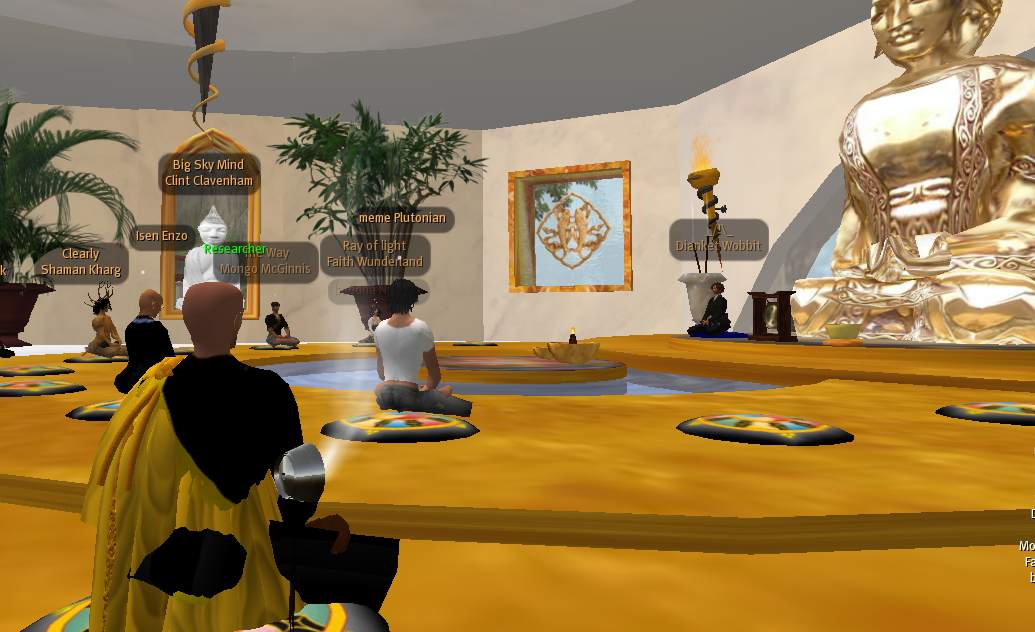 Some of the other speakers on the panel gave a little more information about what Second Life, the online avatar world, is and how Buddhists use it. It is like most other online simulated interactions in that you make your character and can go around in this world to do things, like practice your religion, and meet people, perhaps other Buddhists. A Buddhist belief is that life is impermanent...Second Life is like an extension of this belief because it is impermanent in the same way. But the question, "Do people see what is represented in Second Life as being sacred even though it is not real life?" was brought up and it was stated that some devotees believe that they are different. One of the possible reasons for this might be that in this online world, you are able to send your avatar to a temple to meditate. Is this "extension" of yourself giving you the benefits of meditation if you aren't doing it yourself? Some say that it depends on the person, the medium, and the amount of engagement. As you can see, a lot of debate has circled this topic. What do you think?


 In the second story, Lapcharoensap shows the reader tourism from a different perspective. Instead of outsiders coming into a foreign land, we are seeing locals ‘touring’ their own land. It is the story of a son and his mother going on a trip to bond because she is going blind. Unlike the tourist sense we get from the previous story, this is more about cleansing and communicating. The fact that they don’t stick out gives them the opportunity to travel and have a ‘true’ experience. The story ends with the narrator saying, “I’m walking on the sandbar, warm waves licking up across my bare feet, out to watch the sun rise with Ma, and then to bring her back before the tide heaves, before the ocean rises, before this sand becomes seafloor again” (98). Their travels are not to become worldly or to be able to brag that they have been somewhere, it is to rejuvenate and learn more about their relationship with each other and their culture.
 But how does it work? Well, you come in (with all of your friends) and grab a table. You get a stack of premade letters to sign and address to everyone you know. This is part of what makes the amount of money we raise so astounding...it comes from the people we send letters to! It is their generous donations that make this possible. The donations we receive from them goes to benefiting St. Jude Children’s
